 دار بيبليون

My Memories of Swami Vijayananda, Close Disciple of Ma Ananda Moyi, Testimony by Lwiis Saliba, on Zoom, Wednesday, September 2, 2026
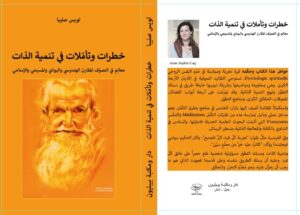
Reflections on Personal Development
Milestones of Comparative Mysticism: Hindu, Buddhist, Christian, and Islamic
Portrait of Vijayananda
This is the title of my latest book in Arabic, book number 100 in my complete works, and I am very happy that it is blessed by the presence of my master, Swami Vijayananda (1914-2010). Several reflections are inspired by his teachings, and his portrait graces its cover.
This is the portrait drawn by Geneviève Koevoets (Mahajyoti), as clearly indicated on the cover and on page 234. Upon seeing this painting, Dr. Jacques Vigne told her, “Geneviève, you have succeeded in drawing not only his face, but also his soul.”
For me, when I look at this portrait, it reminds me of the story of Michelangelo and his famous sculpture of Moses in the Vatican. When he finished his masterpiece, captivated by its beauty, he looked at it and said, “But speak, Moses…”
Every time I look at this portrait of Vijayananda, I say to him, “But speak, Vijayananda…” He is so alive in this portrait.
In the beginning, it was Ma and her photographs.
With the publication of this book, I like to tell my story with my Master, Swami Vijayananda.
It all begins with Ma Ananda Moyi, also called Ma Anandamayi (1896-1982), and Ma’s photographs. Vijayananda said it well and repeated it: Ma left a touch, an imprint of herself, in each of her photographs.
In the 1990s, I was living in Paris. I read Josette and Jean Herbert’s book, “The Teachings of Ma Ananda Moyi.” But what captivated me most were the photos of Ma in Jean Claude Marol’s books.
There was a disciple of Ma in the Paris region: Claude Portal. He lived in Saint Germain en Lay. He invited us to celebrate Ma’s birthdays at his home, as well as Swami Chidânanda’s birthdays. He once told us about this French doctor, Vijayânanda, a disciple of Ma, who had given up everything to live with her as a hermit in Dhaulchina in the Himalayas, and who often comes to Kankhal, where Ma’s mausoleum (Samadhi) is located. The story fascinated me, and I told myself: I will go and meet Vijayânanda one day. First Visit to Ma’s Samadhi
In January 1999, after a spiritual retreat with Swami Chidananda in Rishikesh, and on my way back to Delhi to catch my flight, I stopped in Kankhal. Vijayananda wasn’t there; he was on retreat in Dhaulchina. But there I ran into Dr. Jacques Vigne, whom I had heard of before, but this was our first meeting, which I’ve already recounted.
I told him I was coming to visit Ma’s Samadhi but also wanted to meet Vijayananda.
He replied that he was in Dhaulchina and gave me a copy of Vijayananda’s newly published book, “A Frenchman in the Himalayas.”
Back in France, I read this very interesting book and resolved to return one day to meet Vijayananda. First Encounter with Vijayananda
I didn’t waste any time returning. In January 2000, I was back in Kankhal to spend two weeks near the Samadhi of Ma and with Vijayananda at the International Center for Foreigners.
The program was simple: a morning Arati ritual around 7 a.m. at the Samadhi of Ma, and another in the evening, also around 7 p.m.
Vijayananda came to the evening Arati: a small, unassuming man with a gentle, charming voice. He always carried a small cushion with him, on which he would sit after the Arati, leaning against a wall of the Samadhi, waiting for people to come and see him.
Our first encounter is unforgettable: he looked at me and asked his traditional question:
“U come from where?”
“I’m coming from France, Swamiji.” That was my usual response to avoid the pointless curiosity of the Indians who asked me endless questions about my country of origin, since the Indians in the villages didn’t know it.
“You don’t look like a French person ” Vijayananda replied.
A minute later he asked me this question:
“Aren’t you from Lebanon?”
“And how do you know, Swamiji?” I immediately started using the informal “tu” with him, feeling that we were family and that he was like a father figure.
“You Lebanese have a special signature. And how is Lebanon, this beautiful little country, doing?!” He loved this country, and he desperately wanted it to be at peace, especially with its neighboring region: “It’s a country that has the beauty of the Prophet Joseph, but also the sorrow of his father,” he often told me. With this phrase, he perfectly summed up the tragic situation in Lebanon.
Vijayananda’s Satsangs
From 2000 to 2003: for four consecutive years, I spent two weeks each year in Kankhal. In 2003, I recorded two 45-minute video interviews with him, which are available on YouTube. And every day I waited with impatience I eagerly awaited the meeting with Vijayananda. Every evening he would sit on his cushion and wait for people to come and see him. It was Ma who asked him to look after the foreigners who came to his ashram, and he continued to do so until his last day.
Very often I was alone with him, but I had to prepare questions to ask him, otherwise the session would be ruined.
Sometimes, he would take my place, asking me questions about my country or my sadhana.
“When you live in a country where the situation is difficult, don’t forget that it’s an opportunity for you; you’ll have the chance to progress quickly.”
“But Lebanon is almost constantly at war, either an external war or an internal one. Isn’t that a great danger for me?” “Always try to distance yourself from war zones to find more inner peace, but above all, don’t forget that your karma is attached to your skin. Just because you live in a country that isn’t at war doesn’t mean you’re far from disasters.”
“When you live in a country at war, don’t you suffer the collective karma of its people?”
“There is no collective karma; everyone suffers their own karma! All the great masters have repeated this, including the Dalai Lama.”
“And when thousands of people suffer the same disaster?”
“Everyone suffers their own karma, even in that case. Otherwise, why would you find people who narrowly escape such events?” Vijayananda simply answered the questions.
And here is an example of the discussions between the two of us. I remember that at the Kankhal Ashram International Center, there were booklets of Vijayananda’s satsangs that Jacques Vigne had written and titled “The Kankhal Conversations.” They were printed as mimeographed copies but not published. I would read these conversations during the day to prepare questions for the evening.
It’s difficult for me to talk about my own conversations with him after more than a quarter of a century. I wrote some notes in my old notebooks, and I’ll come back to them one day, but everything I’m recounting here is what has remained in my memory, so deeply are his words etched in my mind.
He had a great sense of humor and often told us anecdotes.
Vijayananda under the German occupation
I remember one time we had this discussion:
“Swamiji: How could you, a Jew, remain in France under the German occupation?” “
-“I wasn’t saying I was Jewish.”
-“What were you saying then?!”
-“I was saying I was Protestant!”
-“So you were lying, Swamiji?!”
-“Not at all, I meant that I was protesting against the German occupation of my country!!” At this unexpected answer, we all had a good laugh.
Ma’s Love
Another time I said to him:
-“Swamiji, some people say, speaking of you and your journey with Ma: that this French doctor eventually fell in love with this beautiful Indian lady and gave up everything to stay with her in India.”
At that, Swami Vijayananda burst out laughing and said to me:
-“Look how people love to invent stories. Let me confess something to you: at first, I didn’t find her particularly beautiful.” “I followed her because she was a true Guru.”
Vijayananda, a personal advisor
What was so touching about Swami Vijayananda was his availability. He listened attentively as I recounted my problems, my difficulties, and so on.
I often asked him for personal meetings, and he granted them. I remember one of them:
I wanted to tell him about my love affair with an Indian woman. At first, I felt a little embarrassed to tell a love story to a Master like him, who was primarily interested in sadhana and the spiritual path, but he encouraged me with his welcoming smile!
I told him about the various problems his mother was having, and so on, and after a long explanation, I finally asked him:
“Swamiji, what do you advise me to do? Should we get married?” He looked at me with a smile and said,
“Listen, try it, and if it doesn’t work, you can get a divorce!” I wasn’t expecting such a brief answer. I burst out laughing, and we both laughed together.
I was expecting serious, spiritual advice, but he simply offered practical advice. He didn’t really believe in marriage; what mattered most to him was sadhana, and marriage could have been a hindrance.
Vijayananda the switchboard operator!
Swamiji often filled in for the switchboard operator at the Kankhal ashram. I took advantage of this opportunity to spend more time in his company. I was there, at the ashram’s reception desk, just to be with him. He was a real cleanliness freak, and in a country as dirty as India, what a paradox! He wrapped the telephone handset in his saffron shawl so as not to touch it, especially because He avoided touching my lips when he spoke.
I enjoyed watching him like that and listening to him answer calls. And since I knew a little Hindi, mostly through the shared vocabulary between Hindi, Persian, and Arabic, I amused myself by piecing together what he was saying to grasp the general meaning. After each call, I would ask him:
“Swamiji, did you say this and that?”
And he would laugh and reply:
“You’re dangerous; you can’t hide anything from me.”
If I couldn’t guess the main topic and the essential details, he would say:
“I’ve won this time.”
He encouraged me to dive headfirst into learning Hindi:
“Learning the language of a people is more about understanding their mentality,” he would tell me. “For Westerners, learning Hindi is rather complicated, but for you, an Easterner, it must have been simpler.”
Vijayananda and Hebrew
“I was also just starting to learn Hebrew at the time; it was part of my research into holy scriptures and Abrahamic religions. When he learned about it, he expressed his joy and advised me to read ‘Tintin’ in Hebrew, something he did regularly. He loved Tintin and would ask his friends and disciples to bring him ‘The Adventures of Tintin’ in Hebrew. I would exchange Hebrew expressions with him, which gave him great pleasure and amused him greatly.
It is a great act of openness for a Lebanese person to learn the language of a neighboring country with which his country is at war; it helps to overcome hatred and the rift in mind and heart.” I confess today that I didn’t have his gift for languages!
A cleanliness fanatic
Regarding his concern for cleanliness, I remember a young French woman once recounting, during one of his Satsangs, that she went to the local markets to buy fruits and vegetables and often ate them without even washing them properly. She expected him to approve of her behavior when she said,
“Hardwar is a holy region; its fruits and vegetables must be blessed.” But she was disappointed:
“My little cell, where I eat, is a veritable operating room; everything is thoroughly sterilized.”
“How could you live in India, a country that isn’t very clean?!” I said to him.
“I’ve always taken precautions, and I continue to do so.”
“Nature triumphs over conditioning, as the Arabic proverb says,” I concluded.
Criteria for Distinguishing Masters
Several times during his satsangs, I asked Swami Vijayananda questions about masters or gurus. Normally, Indian sages, such as Swami Chidananda and Chandra Swami, whom I knew well, don’t answer these kinds of questions. But this wasn’t the case with Swamiji:
“There are two criteria for distinguishing a false master from a true one,” he told me: “money and sex:
1- If you find a master who takes money in exchange for his teaching, he’s not the right one: You have to live spirituality, not live from spirituality.”
He repeated this to us constantly.
2- “If you find anything suspicious in the master’s circle of acquaintances, in relationships, etc., then he’s not a good master.”
And in any case, never forget that yoga is not about worshipping a guru; rather, venerate the teaching, not the teacher.”
He always repeated this advice.
Vorship the teaching, not the teacher.
Swamiji refused any form of veneration that could be offered to him. Such veneration from an Indian can be natural because it is part of their culture, but when it comes from a Westerner, it is rather artificial because they are not accustomed to this “kind of ritual.”
Thus, there was no “Indian folklore” between him and me, unlike between master and disciple. Moreover, Vijayananda advised Westerners against worshipping Hindu gods: they are not suitable for their spiritual path; it is far removed from their culture. He said this and repeated it several times.
Teach for Free
Regarding the teaching of knowledge, he would repeat to us:
“Teach yoga and spirituality in your native language, otherwise it won’t take root in your culture. Teach for free as much as you can,” he would tell us, and he often quoted Jesus’ teaching: {Freely you have received, freely give} (Matthew 10:8). He was very familiar with the Gospel, by the way.
The fact that the teaching was free was proof of its authenticity, according to him.
He encouraged me to write in Arabic: “It’s your mission in the Arab world, which needs this knowledge. The French don’t really need you; they have their writers and their Indologists.”
That’s why, after preparing my thesis in French and starting to write in that language, I am Returning to Arabic, my mother tongue.
Hatha Yoga
Originally, Swami Vijayananda was a great Hatha Yogi. He learned and practiced it in France before coming to India. He strongly emphasized that Hatha Yoga is not competitive; it is not a rivalry like many sports. He also insisted and reiterated that one does not practice yoga postures to show off:
“It is better to stop practicing and choose a sport instead of Hatha Yoga than to show off in front of people by displaying bodily flexibility and difficult postures, as some yogis who are not true yogis do,” he told us.
Vijayananda and the Indian Masters
Regarding contemporary Indian masters, Swami Vijayananda knew them all, most of them personally.
1- Osho Rajnesh: He summed up his opinion of him in a single sentence, saying, “Osho speaks well, he writes well, but he behaves badly.”
2- J. Krishnamurti: He met him several times. He did not consider him an accomplished master. He recounts that in his final days, suffering from great pain, Krishnamurti asked to be given morphine to alleviate his suffering. For Vijayananda, this is not the sign of an accomplished master. He compares him to Ramana Maharshi, whom he greatly admired and who underwent cancer surgery without anesthesia.
3- Swami Sivananda: He respected him greatly and visited him at his ashram in Rishikesh. Sivananda gave him a large number of his books, refusing to accept any payment. But Vijayananda found signs in Sivananda that proved he had not yet reached the highest degree of realization!
4-Maharishi Mahesh Yogi: “At first, I was shocked to see him come to Kankhal to visit Ma Anandamayi in his luxury Mercedes, but then I got used to seeing him arrive in that kind of car,” said Vijayananda. “I believe that the meditation and other techniques he teaches Westerners are good.”
5-Chidvilsananda Guru Mayi: “She is the one who succeeded Muktananda. He told us about the great rivalry between her and her brother for the succession of their master Muktananda: It wasn’t spiritual at all.”
6-Swami Chidananda: “It’s the result of a Jesuit education; that’s where we find the impact of Christianity in his teachings.” Vijayananda greatly valued his friendship and veneration for Ma.
7-Chandra Swami: “His problem is that he doesn’t speak so that we truly know the degree of realization he has attained,” Vijayananda said.
8-Swami Ramdas: or Baba Ramdas, as his disciples call him. Vijayananda told us about his visit to Ananda Ashram, Ramdas’s ashram in South India. There was this conversation between the two:
“Baba Ramdas, could you grant me Realization?”
“I could grant it to you, but in that case, you wouldn’t have the merit of having made the effort!”
“Baba, I don’t care about that merit. If you can grant me realization, please do it without delay.”
The conversation was cut short at this point, as Ramdas had received other visitors at the same time. And Vijayananda concluded:
“Realization, no guru can give it to you, not even Ma Anandamayi. You can only achieve it through your own efforts.”
9- Ma Anandamayi: It remains to be seen that Vijayananda considered Ma to be an Avatar: a divine incarnation whose mission was to restore the ancient Hindu tradition. He often compared her to Jesus Christ. He saw in her the Ideal of a Master. He said that she, along with Ramana Maharshi, were the two greatest gurus of 20th-century India.
Last meeting with Vijayananda
My last meetings with Vijayananda took place during my visit to Kankhal in October 2003. It was during this visit that I recorded two interviews with him, which are currently available on YouTube. A Shiite from southern Lebanon, near the border with Palestine, accompanied me on this visit. Swamiji was pleased to see someone from this border region, or so-called war zone, between Lebanon and its neighbor.
Before leaving, he granted me a private audience. A brief meeting. I didn’t know it would be our last, but he apparently sensed it.
“Remember that hatred never erases hatred, and only love can erase hatred. Remember that only non-violence can calm violence. Love and peace to you, to the person with you, and to all your compatriots. Go and pass this message of love and peace on to all Lebanese people and to everyone you know or meet. Tell them that only love endures.”
I didn’t know it was a kind of last will and testament from my beloved master. And since then, I have only been passing on this message of Love and Peace to everyone I meet.
«»«»«»«»«»([1])
[1] –