 دار بيبليون

Lebanon’s 1920 Settlement Still Shapes a Fragile State, on Book of Lwiis Saliba,
By Farouk Khaddaj | 23 June 2026
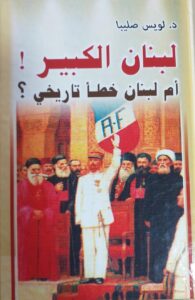
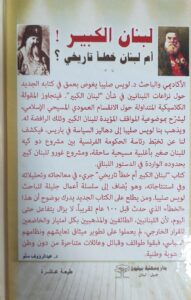
Beirut is a city where history never fully recedes into the past. It remains present in its institutions, its crises, and in the unresolved questions that continue to shape the Lebanese state today. In this sense, Lebanon’s contemporary challenges are not only the product of recent political failures, but also of deeper historical arrangements whose effects continue to unfold.
More than a century after the proclamation of Greater Lebanon in 1920, Dr. lwiis Saliba’s study “Greater Lebanon or a Historical Mistake?”, now in its tenth edition, revisits one of the most enduring questions in modern Lebanese history: whether the original formation of the state established a viable political entity, or a framework that carried within it long-term structural tensions.
The book does not offer a definitive judgment. Instead, it examines the historical conditions under which the modern Lebanese state emerged and the competing visions that accompanied its formation.
A State Formed in a Regional Transition
Saliba situates the creation of Greater Lebanon within the broader transformation of the post-Ottoman Middle East. The collapse of the Ottoman Empire and the establishment of European mandates led to a wide reconfiguration of political boundaries across the region, including the formation of Lebanon under French administration.
The expansion of Mount Lebanon into a larger territorial entity brought together coastal cities, inland agricultural regions, and mountainous districts under a single administrative framework. While this created a functioning state structure, it also introduced long-term questions about cohesion and political integration.
According to historian Abdel Ra’ouf Sinno, local leaderships played an active role in shaping this process. Maronite religious and political figures, including Patriarch Elias Hoyek, supported the creation of a larger Lebanese entity under French protection, viewing it as a means of securing stability during a period of regional uncertainty.
Diverse Positions Within the Christian Community
Saliba’s work highlights the internal diversity within Lebanon’s Christian communities at the time of state formation. Political positions were shaped by differing interpretations of geography, economy, and regional belonging.
Greek Orthodox figures, along with intellectuals such as Suleiman Bustani, expressed reservations about the new political structure. Their concerns focused primarily on the consequences of separating coastal urban centers from their natural economic and cultural hinterland in Syria.
These positions reflected broader debates about the sustainability of a political entity whose boundaries had been significantly redefined in the aftermath of the Ottoman collapse.
The book also references figures such as Naguib Sursock, whose critical reflections on the early state have been widely cited in discussions about Lebanon’s founding and its structural tensions.
Structural Tensions in the Founding Framework
A central argument in Saliba’s study concerns the structural tension embedded in the creation of Greater Lebanon. The territorial expansion strengthened the state’s economic base, but also altered demographic balances that had previously shaped governance in Mount Lebanon.
This development contributed to the emergence of a political system based on sectarian power-sharing, designed to manage diversity within a single institutional framework. While this arrangement allowed for a degree of stability, it also introduced limitations in terms of institutional development and state capacity.
Over time, the interaction between demographic change and political representation became a persistent source of tension in Lebanese public life.
Regional Context and Limited Choices
The book places these developments within the constraints of the wider regional environment. The post-First World War settlement, particularly the Sykes–Picot framework and the establishment of French and British mandates, significantly limited the range of political options available to local actors.
Alternative proposals, including visions of a broader Syrian political framework, were constrained by military and diplomatic developments, most notably the fall of the Faisal administration in Damascus following the Battle of Maysalun in 1920.
At the same time, Saliba notes that regional nationalist movements were themselves diverse and evolving, reflecting a range of political and social currents across the Levant.
An Ongoing Process of State Formation
In its later sections, the book describes Greater Lebanon as a political entity whose formation has remained incomplete in several respects. Rather than stabilizing into a fully consolidated state, Lebanon has experienced successive cycles of adjustment and crisis.
The post-Taif framework, established in 1989, represented a significant attempt to recalibrate political representation following the civil war. However, questions related to institutional cohesion within a sect-based system continue to shape debate among scholars and policymakers.
Reading History as Context, Not Verdict
Brigadier General Ali Abi Nacef highlights Saliba’s methodological approach, particularly his reliance on archival sources and historical documentation. This allows the book to present multiple perspectives without reducing them to a single interpretive framework.
The result is an analysis that seeks to understand the conditions of state formation rather than deliver a final judgment on its outcome.
Conclusion: Between History and Institutional Reality
A century after its establishment, Lebanon continues to reflect the complexity of its origins. It remains a state shaped by historical compromise and regional transformation, while still grappling with questions of governance, identity, and institutional capacity.
Saliba’s study does not seek to determine whether the creation of Greater Lebanon was a success or a failure. Instead, it encourages a closer examination of how historical arrangements continue to influence present realities.
Lebanon today exists within a long historical continuum. Its future will depend less on revisiting foundational debates, and more on the capacity of its institutions to adapt to evolving regional and domestic conditions.